Building Tomorrow – report of the Horasis Global Summit, Medellin, Colombia, 10-13 November
By Frank-Jürgen Richter
November 25, 2026
The eleventh Horasis Global Summit convened in Medellín, Colombia, from 10 to 12 November 2026, bringing together a remarkable international community of leaders from business, government, academia and civil society. For the first time, the global gathering took place in Colombia. Against a global strategic rivalry, technological upheaval and widening economic and social disparities, the Summit asked a question of unusual urgency: what must humanity build now to secure a future worthy of the generations that follow?
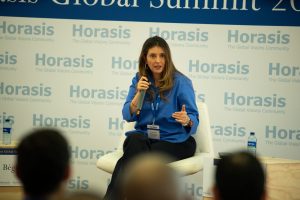
Paloma Valencia, Former Senator and Presidential Candidate, Colombia
The answer cannot be entrusted to any single nation, institution or technological breakthrough. It demands a renewed capacity for common purpose. At a moment when political boundaries are hardening and confidence in established institutions is under strain, the summit affirmed the enduring importance of dialogue across borders, generations, sectors and convictions. Horasis has always sought to create the conditions in which such encounters can occur. In Medellín, that mission acquired particular resonance. The theme, Building Tomorrow, expressed an intentional progression beyond diagnosis. The global community is well acquainted with the threats confronting it. What remains insufficient is the collective determination to construct durable responses: economies that generate opportunity, technologies governed by human values, institutions capable of earning trust, and societies able to reconcile prosperity with the protection of nature.

Summit co-host Claude Béglé, Chairman, Symbioswiss, Switzerland
The gathering brought together 850 speakers from across the world, making Medellín a meeting place for perspectives drawn from business, government, academia and civil society. Medellín was more than the host city. It was a living expression of the Summit’s central proposition: that tomorrow is neither predetermined nor beyond human influence. A city once internationally associated with violence and division has undertaken a long and unfinished journey of civic renewal. Its investments in urban mobility, education, public space, entrepreneurship and innovation have made it an important point of reference for cities confronting profound social and economic challenges.

Nestor Raul Posada Arboleda, Rector, Universidad de Medellín´welcomed by Frank-Jürgen Richter
The transformation of Medellín is neither a simple success story nor a claim that deep inequalities have disappeared. Its significance lies in demonstrating that institutional persistence, civic imagination and partnerships among public authorities, businesses, universities and communities can alter a city’s trajectory. Progress remains contingent on inclusion, security, social mobility and the ability to extend opportunity beyond the most visible centers of growth.
Colombia offered the Summit a wider national perspective. Its biodiversity, human talent, agricultural potential, entrepreneurial dynamism and strategic position between the Pacific and Atlantic worlds create substantial possibilities for international engagement. At the same time, the country must navigate persistent social disparities, regional inequalities, infrastructure needs and the challenge of securing long-term confidence in institutions and investment.

Ana Maria Béglé, Latin America Director, Horasis, during the Grand Opening
The discussions in Medellín placed Colombia within a larger transformation of the international economy. Emerging countries increasingly seek a more decisive voice in the institutions and markets that influence their future. Yet influence will depend not only on natural resources or demographic advantage, but on the capacity to develop knowledge-intensive industries, strengthen education, maintain predictable frameworks and create value that reaches local communities.
The Summit met at a time of heightened international anxiety. Wars and prolonged conflicts have inflicted grave human suffering while weakening confidence in the norms intended to restrain violence. Great-power competition has complicated diplomacy, trade and technological cooperation. Supply chains are being reconsidered through the lenses of resilience and national security; economic openness increasingly coexists with industrial policy, strategic protection and geopolitical calculation. Meanwhile, uneven growth, financial pressures and unequal access to opportunity continue to test the legitimacy of economic systems.
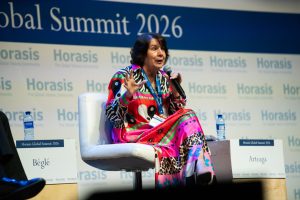
Climate change and biodiversity loss expose the limits of development models that treat the natural world as an inexhaustible reserve. Artificial intelligence promises major gains in discovery and productivity, yet also introduces profound questions about employment, accountability, concentration of power and the future of human agency.
No serious response to these challenges can be confined to one discipline. The climate transition is inseparable from finance and technology; the future of work is inseparable from education and social protection; peace is inseparable from dignity and the credibility of institutions. Horasis therefore brought together perspectives that might otherwise remain separated by geography, profession or ideology. The objective was not artificial consensus, but a more informed and constructive understanding of our shared responsibilities.
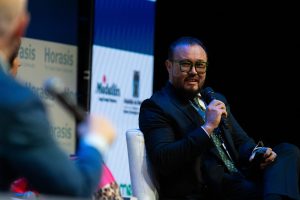
Fahim Hashimi, Former Minister of Communications and IT, Afghanistan, making a point
The Grand Opening established Medellín as both the setting and an active participant in the search for a more inclusive future. Maria Fernanda Galeano, Secretary of Development, City of Medellin, Colombia, brought attention to the importance of creating opportunity throughout Medellín’s neighborhoods; Nestor Raul Posada Arboleda, Rector, Universidad de Medellín, Colombia, considered the university’s responsibility to cultivate critical inquiry and civic purpose; Frank-Jürgen Richter, Chairman, Horasis, Switzerland, explored the need to turn global diagnosis into practical construction; Ana Maria Béglé, Latin America Director, Horasis, Switzerland, connected these concerns to the possibilities opened by international partnerships rooted in the host city; Claude Béglé, Chairman, Symbioswiss, Switzerland, drew the discussion toward the patience and trust required to make cooperation endure. The opening therefore connected the international agenda to the responsibilities of the host city, the university and the global Horasis community.

The plenary on Building Tomorrow set out the intellectual ambition of the Summit: to connect economic resilience, technological progress and social responsibility in a coherent program of action. Rosalia Arteaga, Former President of Ecuador, Ecuador, brought attention to the social and educational foundations of lasting progress; Claude Béglé, Chairman, Symbioswiss, Switzerland, considered the value of cooperation across institutions and national boundaries; Fahim Hashimi, Chairman, Hashimi Group; Former Minister of Communications and IT, Afghanistan, explored the resilience required of societies confronting disruption and political uncertainty; Maria Camila Villegas, Executive Director, Fundación Grupo Argos, Colombia, connected these concerns to the importance of connecting economic ambition to the strength of communities; With Kenneth N. Frankel, President, Canadian Council for the Americas, Canada, guiding the conversation, the panel considered the shared responsibilities of leadership across the Americas.
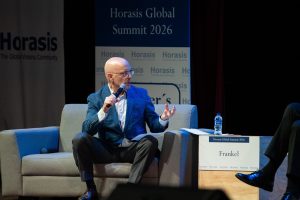
Kenneth N. Frankel, President, Canadian Council for the Americas, Canada
The exchange established a central principle for the days ahead: durable progress requires institutions and people capable of acting together across divisions.
The World Economic Outlook conversation considered uneven growth, demographic change and the effects of geopolitical fragmentation on confidence and investment. Maria Cristina Frias, Partner, Grupo Folha, Brazil, brought attention to the need for reliable information and public confidence in uncertain markets; Margareth González, Founder and Chief Executive Officer, Capital Variation, Germany, considered the importance of investment horizons that extend beyond the next cycle; Cristian Halaby, Chairman and Chief Executive Officer, BYCSA, Colombia, explored the productive capabilities that make companies and economies competitive; Victor Ponta, Former Prime Minister of Romania, Romania, connected these concerns to the role of economic diplomacy when geopolitical divisions intensify; With Catherine Carlton, Council Member and Former Mayor, Menlo Park, USA, guiding the conversation, the panel considered the effects of economic choices on jobs, communities and future generations.
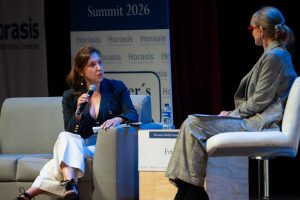
Maria Cristina Frias, Partner, Grupo Folha, Brazil
Taken together, the contributions suggested that resilience rests on credible institutions as much as on financial resources.
The Climate and Nature plenary placed ecological integrity at the center of the economic agenda, linking biodiversity and resource stewardship to livelihoods and public accountability. William Bohnett, Chairman, Smithsonian Environmental Research Center, USA, brought attention to the ecological systems on which economic resilience depends; Iván X. Eskildsen, Former Minister of Tourism; Founder and CEO, OGAYA Travel, Panama, considered the potential to align conservation with sustainable livelihoods and tourism; Gladys Martínez, President, Interamerican Association for Environmental Defense, Costa Rica, explored environmental justice and the participation of affected communities; Rodrigo Paris, Diplomat, Journalist and Philanthropist, Colombia, connected these concerns to the responsibilities accompanying Latin America’s extraordinary natural wealth; Ceres Scattolini, Co-founder and President, Instituto Biofílica, Brazil, drew the discussion toward the opportunity to build regenerative relationships with nature; With Nisaa Jetha, Founder, ImpactforSDGs, United Kingdom, guiding the conversation, the panel considered the importance of translating climate commitments into measurable results.

Margareth González, Founder and Chief Executive Officer, Capital Variation, Germany
Its underlying message was that conservation and prosperity can reinforce each other when communities share in the decisions and benefits.
The debate on Steering the Technological Age examined how artificial intelligence, digital infrastructure and frontier innovation are changing productivity, security and the balance of power. Cordell Carter, Founder, The Festival of the Diaspora, USA, brought attention to the importance of inclusive participation in the technological transition; Jerry Hultin, Chief Executive Officer, Global Futures Group; Former US Under Secretary of the Navy, USA, considered the strategic responsibilities created by innovation and security risks; Raj Nandwani, Chairman, Artha Institute, UAE, explored the investment and institutional choices needed to deploy technology responsibly; Nima Schei, Founder, Hummingbirds.Ai, USA, connected these concerns to the opportunities and risks associated with rapidly evolving intelligent systems; With Jessica Brice, Senior Investigative Reporter, Bloomberg News, USA, guiding the conversation, the panel considered the necessity of public scrutiny and accountable technology governance.The debate underscored that technical progress and the institutions governing it must advance together.
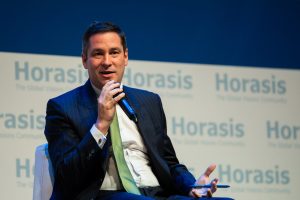
Cristian Halaby, Chairman and Chief Executive Officer, BYCSA, Colombia
The conversation on Power, Peace and Global Order confronted the limitations of coercion as a foundation for stability and the importance of legitimacy, reconciliation and shared rules. Sadhvi Bhagawati, Secretary-General, Global Interfaith WASH Alliance, India, brought attention to the moral and spiritual dimensions of human security; Martín Burt, Founder and Executive Director, Fundación Paraguaya, Paraguay, considered the relationship between dignity, opportunity and lasting peace; Sekai Holland, Chairperson of Board of Trustees, Zimbabwe Peacebuilding Initiative, Zimbabwe, explored the difficult work of reconciliation after division and conflict; Camila Uribe Villa, Executive Director, Casa de las Estrategias, Colombia, drew the discussion toward the importance of community-level peacebuilding and civic trust; With Cynthia Johnson, Co-Founder and Chief Executive Officer, Bell + Ivy, USA, guiding the conversation, the panel considered the challenge of sustaining dialogue amid differences of power and belief. The perspectives converged on the need for forms of peace that acknowledge power while giving dignity and cooperation a lasting place.
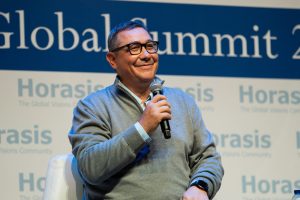
Victor Ponta, Former Prime Minister of Romania
The Plenary on Building Together in a fragmented world asked which forms of cooperation can survive competing interests and weakening institutional confidence. Bo Inge Andersson, President, Ivanhoe IV, USA, brought attention to the disciplines of leadership and enterprise under pressure; Marcela Fernandez, Founder, Cumbres Blancas, Colombia, considered the need to protect natural systems through collective action; Valentina Jordan, Chief Executive Officer, Nauta, USA, explored the value of partnerships that link investment with practical outcomes; Anthony Robinson, Executive Director, Netroots Nation, USA, connected these concerns to the role of civic participation and networks in sustaining cooperation; With Parag Amin, Chief Mentor and Founding Director, iCreate, USA, guiding the conversation, the panel considered the possibility of converting shared ideas into implementable alliances. The resulting challenge was practical: to build alliances with enough trust, capacity and continuity to produce visible results.
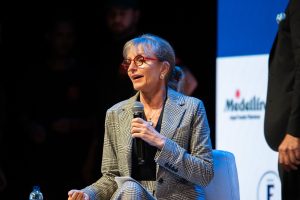
Catherine Carlton, Council Member and Former Mayor, Menlo Park, USA, chairing the World Economic Outlook panel
The plenary panel on Democracy placed Colombia’s democratic tradition at the center of a broader reflection on the relationship between political freedom, institutional stability and long-term prosperity. Paloma Valencia, Former Senator and Presidential Candidate, Colombia, offered a perspective rooted in the country’s political experience, highlighting the importance of strong democratic institutions, the rule of law and the protection of individual liberties. Her contribution brought particular attention to the need for democratic systems to respond to citizens’ aspirations, strengthen confidence in public institutions and create the conditions for entrepreneurship, investment and social mobility. Colombia’s democratic resilience, despite decades of internal conflict and profound social challenges, provided an important reference point for considering how political pluralism, civic participation and accountable government can contribute to national renewal.
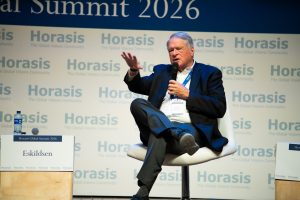
William Bohnett, Chairman, Smithsonian Environmental Research Center, USA
In conversation with Claude Béglé, Chairman, Symbioswiss, Switzerland, who chaired the plenary, the discussion also explored the international significance of democratic legitimacy and the relationship between political trust, economic confidence and cooperation across borders. The exchange reinforced the conviction that democracy must continually demonstrate its capacity to deliver opportunity, protect fundamental freedoms and give citizens a meaningful voice in shaping their future. In this sense, Colombia’s democratic experience offered lessons extending well beyond Latin America, reminding participants that the institutions of tomorrow must be built upon the confidence and active participation of the people they serve.

Iván X. Eskildsen, Former Minister of Tourism, Panama
Cooperation is valuable as a principle, yet its real achievement lies in the capacity to build institutions and relationships that survive changes in leadership, funding and political circumstance. Medellín itself offered an appropriate setting for such a conversation: a city whose international significance is closely associated with the ability to imagine renewal and mobilise people around it. The Summit’s concluding plenary, Building Common Ground, carried this argument into the broader questions of economic governance, planetary responsibility and the future of knowledge.
Jenny Lindo, National Comptroller for Economy and Public Finance of Colombia, Colombia, offered a perspective grounded in public accountability: a prosperous future requires institutions capable of protecting public trust through transparency and responsible stewardship. Jojo Mehta, Co-Founder and Chief Executive Officer of Stop Ecocide International, United Kingdom, extended the moral horizon of the discussion: our understanding of responsibility must include the living systems on which every economy and society depends.

Gladys Martínez, President, Interamerican Association for Environmental Defense, Costa Rica
Marcelo Zuffo, President of Inova USP, Brazil, brought scientific and technological capability into the same frame, suggesting that knowledge creates its greatest public value when research, entrepreneurship and institutions work together to solve shared challenges. Their contributions made clear that common ground does not require identical priorities. It requires agreement on the responsibilities that no society can discharge in isolation. The rapporteur’s report by Benjamin J. Butler, Founder of Embassy of the Future, Hong Kong, offered an opportunity to consider the imagination as well as the institutions of tomorrow.
His proposed reflection was that the future becomes more attainable when we develop the courage to imagine alternatives and the discipline to begin building them together. The plenary was chaired by Preity Üpala, Founder of The Omnia Institute, USA, who drew the discussion towards a central challenge: dialogue has fulfilled its purpose when participants leave with a deeper understanding of one another and a stronger willingness to act. In that spirit, the closing session looked beyond the exchange of ideas to the responsibilities carried home by the participants.
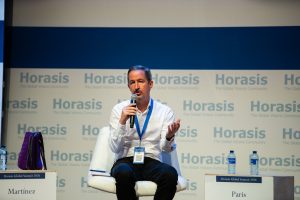
Rodrigo Paris, Diplomat, Journalist and Philanthropist, Colombia
In the closing words, Ana Maria Béglé, Latin America Director of Horasis, Switzerland, was invited to reflect on the relationships established across the region: the enduring value of this gathering will be found in the partnerships and initiatives that continue long after Medellín. Claude Béglé, Chairman of Symbioswiss, Switzerland, placed cooperation within a longer historical perspective: at a moment of fragmentation, the ability to build bridges between institutions and cultures is a strategic necessity. Frank-Jürgen Richter, Chairman of Horasis, Switzerland, returned to the Summit’s guiding theme: building Tomorrow is a shared responsibility. The dialogue we have begun here must become the foundation for practical cooperation, renewed trust and lasting progress.

Ceres Scattolini, Co-founder and President, Instituto Biofílica, Brazil
The Horasis Global Summit closed with a conviction that had been strengthened rather than simplified by the diversity of its debates. The future will be shaped by technological advances and economic choices, but also by the quality of institutions, the resilience of communities and the willingness of leaders to listen across differences. No single actor can resolve the pressures confronting humanity.
The task is to build the conditions in which many actors can contribute, where disagreement does not foreclose cooperation and where ambition is matched by responsibility. The relationships formed in Medellín offer a starting point for that work. The challenge now is to carry them forward.
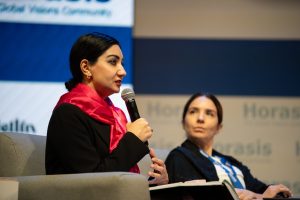
Nisaa Jetha, Founder, ImpactforSDGs, United Kingdom, chairing the plenary panel on climate change
Horasis extends its deepest appreciation to the City of Medellín and Mayor Federico Gutiérrez for their warm welcome and support, and to the Universidad de Medellín and its leadership for providing an inspiring home for this global gathering.
Our sincere gratitude goes to the Summit’s sponsors and corporate partners, whose confidence in the Horasis mission and generous contributions helped make this gathering possible. We are equally indebted to the speakers, moderators and participants who travelled from across the world, bringing their experience, wisdom and commitment to a shared endeavour.
Special thanks are due to the organising team, particularly Ana Maria Béglé and Claude Béglé, whose dedication and belief in the power of international dialogue contributed so greatly to the success of the Summit.
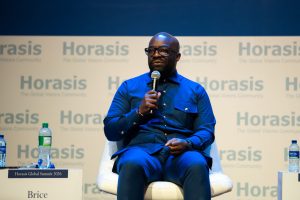
Cordell Carter, Founder, The Festival of the Diaspora, USA
As we look towards the next Horasis Global Summit in 2027, we warmly invite our community to come together once again, renewing friendships, strengthening partnerships and continuing the conversations initiated in Medellín.
The challenges facing humanity will not diminish, and many of the questions raised during these days will remain with us. Yet the spirit of openness, imagination and cooperation that characterised our gathering gives us confidence in our collective capacity to address them.
Horasis remains firmly committed to inspiring the future and serving as a global laboratory for tomorrow, a place where emerging ideas can be explored, established assumptions questioned and new possibilities imagined. We believe that the future is neither predetermined nor beyond our influence. It is shaped through the choices we make, the institutions we strengthen and the partnerships we forge.
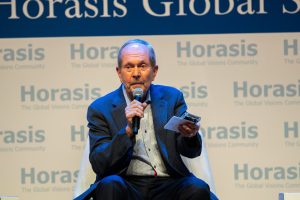
Jerry Hultin, Former US Under Secretary of the Navy, USA
Horasis will continue to provide a trusted platform where leaders from business, government, academia and civil society can think beyond immediate pressures, develop fresh perspectives and translate dialogue into meaningful action.
Our ambition is to nurture a community that combines the courage to imagine different futures with the responsibility to help bring them into being.
The Horasis Global Summit in Medellín has reminded us that even in a fragmented world, common ground can be found and collective purpose renewed. We leave Colombia with new friendships, fresh inspiration and a strengthened conviction that dialogue remains one of humanity’s most powerful instruments for progress.
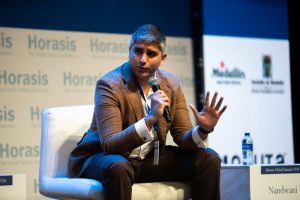
Raj Nandwani, Chairman, Artha Institute, UAE, making a point on a plenary panel
We look forward to welcoming our friends, longstanding and new, to the next Horasis Global Summit, as together we continue the work of Building Tomorrow.
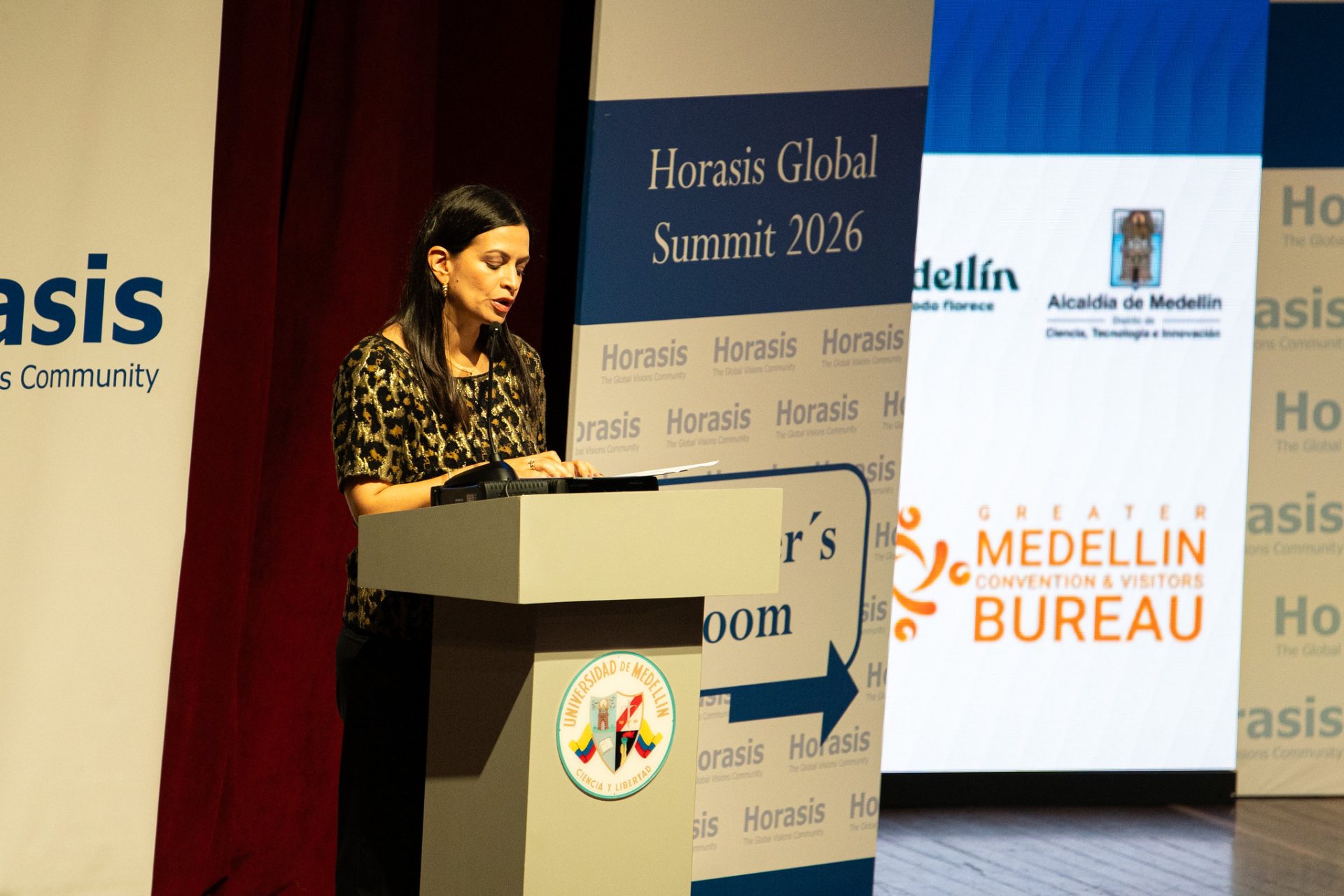
Article’s featured photo of Maria Fernanda Galeano, Secretary of Development, City of Medellin, welcoming participants
…